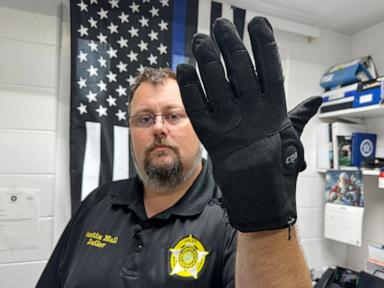
Immigration and Customs Enforcement decided to spend millions on gear designed to hurt people into submission. If you think equipping federal officers with electric shock gloves is just standard law enforcement procedure, you haven't looked at the actual testing data.
A newly unearthed U.S. Army study reveals that the specialized electroshock gloves ICE plans to field caused "intense pain" and immediate, fear-driven compliance during military evaluations. Despite these alarming findings, the agency moved forward with a multi-million-dollar contract anyway.
Let's look at what these devices actually are, what the research shows, and why watchdogs are sounding the alarm.
What Are These Electric Shock Gloves
The devices in question are known as G.L.O.V.E. models, which stands for Generated Low Output Voltage Emitter. Manufactured by Compliant Technologies in Kentucky, they look and function like regular tactical gloves on the surface. An officer flips a switch to activate an electrical circuit built into the palm and fingers.
When the gloved hand makes direct contact with bare skin, it delivers a high-voltage, low-amperage shock. The manufacturer and supporting agencies market them as a humane de-escalation tool. They argue that quick pain compliance keeps officers safe and cuts down on the need for lethal force.
Jail administrators in a few local facilities already use them. They claim that just flashing the indicator light is enough to deter detainees. But scaling this technology up for federal immigration enforcement is a completely different ballgame.
What the Army Study Actually Found
Before ICE locked in a contract for thousands of pairs, the technology underwent evaluation during a military exercise. The results weren't subtle.
Participants in the military evaluation reported that the shock caused intense, immediate pain that forced them to stop resisting right away. More importantly, the test subjects experienced severe fear of getting hit with another exposure.
The evaluation also flagged how environmental factors change the output. Participants who were wet or had oil on their skin experienced exponentially worse shocks. One test subject reported lingering physical discomfort for half an hour after the exposure.
An Army study finding that a tool causes "intense pain and fear" should trigger red flags. Instead, ICE went ahead with a $16.7 million contract for 6,000 pairs of the gloves.
Why Critics Say This Is Dangerous
Civil rights groups and government watchdogs are furious about the acquisition. Chioma Chukwu, executive director of American Oversight, pointed out that the military assessment shows the gloves inflict intense pain without ever establishing that they're safe for the people subjected to them.
Several critical issues make these gloves uniquely concerning for immigration enforcement:
- Invisible Force: Unlike a traditional Taser that shoots barbs and leaves a clear physical paper trail or visible sparks, shock gloves require close physical contact. An agent can grab someone's wrist in a crowded setting, deliver a debilitating jolt, and leave no obvious mark on video.
- High-Risk Populations: The manufacturer's own product manuals warn against using the gloves on vulnerable groups, including small children, pregnant women, the elderly, and individuals with severe health handicaps.
- Lack of Oversight: Sixteen U.S. senators recently pressed ICE for answers regarding deployment plans and specialized training requirements. They haven't received meaningful responses, leaving the public completely in the dark.
Where Things Stand Now
White House border czar Tom Homan indicated that widespread field deployment might take some time as officials hash out training guidelines and internal policies. But the procurement is already moving forward.
If you're wondering how federal agencies justify adopting pain-compliance tools without rigorous safety vetting, the answer usually comes down to operational convenience. Accountability groups will keep pushing for transparency, but until every single use of these gloves is strictly logged and audited, a lot of people are going to pay the price for a silent, invisible shock.