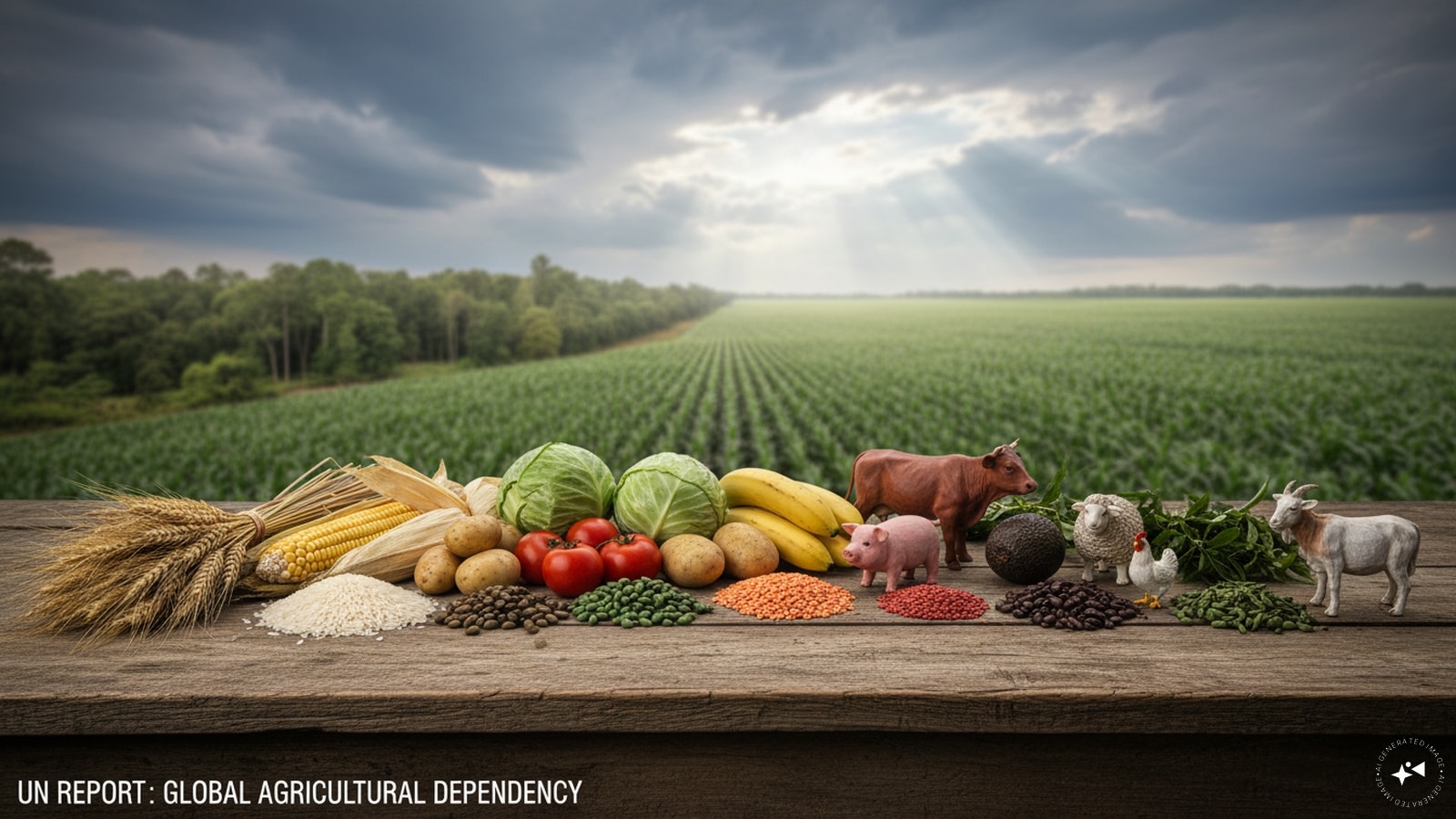
Walk down the middle aisles of any standard grocery store and you'll witness a fascinating illusion of abundance. Shelves groan under the weight of thousands of unique packages, colorful boxes, and branded snacks. Yet, behind this manufactured variety lies a stark and precarious reality. Three-quarters of the entire human diet rests on the shoulders of just 12 plant species and 5 animal species.
Think about that for a second. Out of the hundreds of thousands of edible plants and animals available on Earth, our modern global civilization has funneled its survival into a hyper-narrow bottleneck.
The Food and Agriculture Organization of the United Nations has repeatedly flagged this agricultural homogenization as a silent threat to long-term food security. When societies build their entire nutritional foundation on a minuscule handful of staples—primarily rice, maize, wheat, and a few livestock animals—we aren't just eating a repetitive diet. We are rolling the dice with global survival.
The Dangerous Narrowing of Our Plates
Why did this happen? Human agriculture didn't start this way. Over millennia, indigenous communities and traditional farmers cultivated thousands of distinct crops tailored to local microclimates, soils, and seasonal shifts.
Industrialization changed everything. In the twentieth century, efficiency became the absolute god of agriculture. Governments, corporations, and large-scale producers realized that standardizing crops allowed for massive economies of scale. Planting thousands of acres with a single, high-yielding variety of corn or wheat makes harvesting, transporting, and processing infinitely easier.
The trade-off was brutal. Agricultural biodiversity plummeted. Today, just three grass crops—rice, maize, and wheat—account for roughly sixty percent of all plant-derived calories and proteins consumed by humans.
This hyper-focus creates massive blind spots in global nutrition. Modern staple crops are heavily calorie-dense but frequently poor in essential micronutrients, vitamins, and diverse proteins. Strip away the processing or look closely at the raw nutritional profiles, and you see that our current food system trades breadth of nourishment for sheer volume.
History Has Already Warned Us
Relying on a single biological variety is a gamble that has already backfired spectacularly in human history.
Between 1845 and 1849, Ireland experienced a catastrophic famine because the country's population depended almost entirely on a single variety of potato for sustenance. When an airborne fungus known as potato blight swept across the fields, it wiped out the entire crop within weeks. Over a million people died, and another million fled the island.
The lesson was clear, yet modern agriculture keeps making the exact same mistake on a planetary scale. Take the Cavendish banana, which dominates global export markets. Because commercial banana plants are sterile clones propagated through suckers rather than seeds, every single Cavendish banana is genetically identical.
Right now, a soil fungus called Panama disease Tropical Race 4 is tearing through banana plantations across continents. Because there is zero genetic diversity among commercial bananas, the pathogen faces no natural resistance barriers. Without a major shift, the fruit we buy today could face the same fate as the historical Irish potato.
When pests, diseases, or shifting weather patterns target a monoculture, they don't just damage a farm—they threaten the entire global supply chain.
The Pressure on Farmers and Soil
It isn't just consumers and supply chains that suffer under this system. Farmers find themselves trapped in a rigid industrial loop.
Agricultural conglomerates and major food manufacturers dictate which raw ingredients meet their strict inventory standards. If you're a farmer today, you grow what the processing plants buy in bulk. Growing heirloom varieties or experimental ancient grains means taking on immense financial risk with little to no local market infrastructure to support you.
This dynamic drives intense competition, pushing profit margins razor-thin and forcing many smaller operations out of business entirely. Furthermore, planting the same few crops year after year strips the soil of specific nutrients, requiring heavy applications of synthetic fertilizers and chemical pesticides to maintain yields.
It is a feedback loop of ecological degradation. The more we rely on a dozen species, the more artificial support those species require to survive in exhausted soils.
Breaking the Monoculture Habit
Fixing this vulnerability doesn't require a radical, overnight collapse of modern farming. It starts with shifting market demand one meal at a time.
If you want to support a more resilient food system, your grocery cart is your ballot. Look past the standard aisle staples and actively seek out alternative grains, ancient legumes, and resilient indigenous crops.
- Diversify your grains: Swap out standard white rice or refined wheat for nutrient-dense alternatives like millet, sorghum, amaranth, or teff.
- Embrace overlooked legumes: Bring lentils, chickpeas, and cowpeas into your regular cooking rotation instead of relying solely on mass-produced soy and corn derivatives.
- Support local seed savers: Farmers markets often feature heirloom vegetables and regionally adapted crops that commercial supermarkets refuse to stock due to cosmetic standards.
Biodiversity is the ultimate insurance policy against climate volatility, shifting pest populations, and unexpected crop failures. By expanding what we choose to put on our plates, we force the agricultural market to expand what it chooses to grow. Stop treating food variety as a luxury when it is actually a biological necessity.